Sunday, March 20, 2005

Bird TLC @ ASLC


My daughter Cassie and I spent this past weekend in Seward, Alaska. She hadn't been there since she was a todler, so she didn't remember much of it. We got to visit with some old friends of mine and visit the sites. My favorite place to visit, is the Alaska SeaLife Center. I think it's her favorite now also.

ASLC is really neat. It's motto is "The Alaska SeaLife Center is dedicated to understanding and maintaining the integrity of the marine ecosystem of Alaska through research, rehabilitation and public Education". They caretake a lot of different mamals and sea and shore birds. They also educate the public on the birds, mamals and sealife they work with. Whenever they have a land based bird they transfer it to Bird TLC. Bird TLC sends all of the sea and shore birds to ASLC. It's a good relationship.

Steve Ross and Lisa Pajot were there presenting owls from Bird TLC. Steve presents a great horned owl and Lisa presents a boreal owl. Sorry Lisa, for some reason your picture didn't turn out. Both are well experienced presenters for Bird TLC and have extensive knowledge of the birds they present. They had a good size crowd listening to their presentation and asking lots of questions.

Cassie and I had a really good time and it looks like the owl watchers did also. I added some pictures from the trip to the photo album and will get the rest in there this week.

On another note, I'll be tied up at work for the next couple of days. Chances are there will be no new post until later this week.

Saturday, March 19, 2005

New Small Bird Room equipment donated


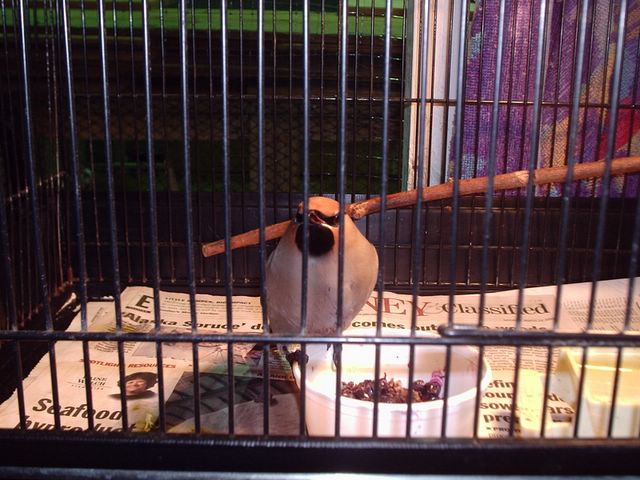
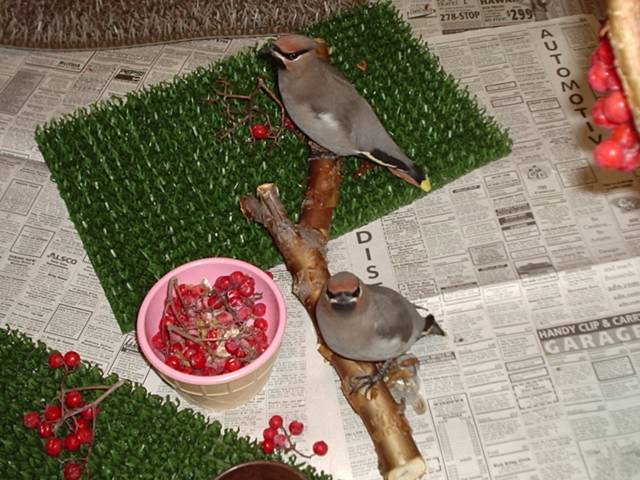
This bohemien wax wing is enjoying it's new rehab cage while it recovers from a window hit.

Bird TLC's small bird room is now more organized, clean and has lots more room. It will also make it easier to keep clean, freeing up volunteers time for other work.

Bird TLC was donated several small bird cages from "The Reef", formally known as "The House of Critters". It has changed it's business to dealing strictly with aquariums, fish and supplies. Having three aquariums myself, I was excited that a business I frequented was donating such needed and nice equipment.

Though the room is not finished being reorganized, it's well on it's way. Summer seems to be coming early to Alaska this year, so the timing of this donation was perfect.

Thanks to the fine people at The Reef!

Wednesday, March 16, 2005

Big City Bird

Everyone should of heard of Pale Male, a red tailed hawk by now. In December, the board of a co-op apartment building evicted him from his New York City apartment over looking Central Park. The board later bowed to public outrage and pressure from the city and environmentalists, and restored a row of anti-pigeon spikes that the hawks had used to anchor their nest. Pale Male and Lola immediately rebuilt their nest.

Now Pale Male and his mate Lola, have at least one egg in their nest according to the Pale Male.com web site run by Lincoln Karim. The male hawk has sired 23 chicks with four mates since he first set up housekeeping at 927 Fifth Ave. in 1993.

Volunteers use the Web site to record every detail of the hawks' lives.

"Lola appears to be turning the eggs every half hour or so. Pale Male had two sittings today between noon and sunset," said an entry posted Sunday.

www.palemale.com

NYC Audubon Society

Sunday, March 13, 2005

Identifying Small Birds Class

IDENTIFYING SMALL BIRDS
April 2, 1:00 - 2:30 p.m.
Bird Treatment & Learning Center
6132 Nielson Way

A bird in the hand is sometimes harder to identify than two in the
bush. Chris Maack will guide you through ways of narrowing it down.
Nestlings will be discussed. The training will be tailored for
rehabilitators who must make critical decisions regarding nutrition and housing. Free to members and volunteers. Call Bird TLC @ 562-4852 to register or sign up at the Bird TLC Clinic.

Some field guides will be available, but bring your own if possible.

Saturday, March 12, 2005

How sharp is it?


This Sharp Shinned Hawk flew into a window and shattered her left wing last year. Not much could be done, so we wrapped her wing and hoped for the best. We figured she would be an un-releasable education bird at best once she recovered.

Well, after a few accidental flight test, we might be considering releasing her this summer. The decission has not been made, but it's a possibility. To look at her x-ray you would think there's no way. But let her loose and she makes you think twice. We'll keep you updated on Sharpie.

Friday, March 11, 2005

Eagle Handler


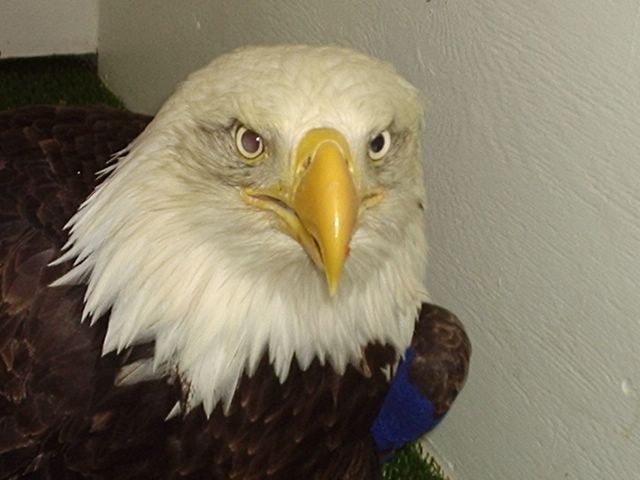
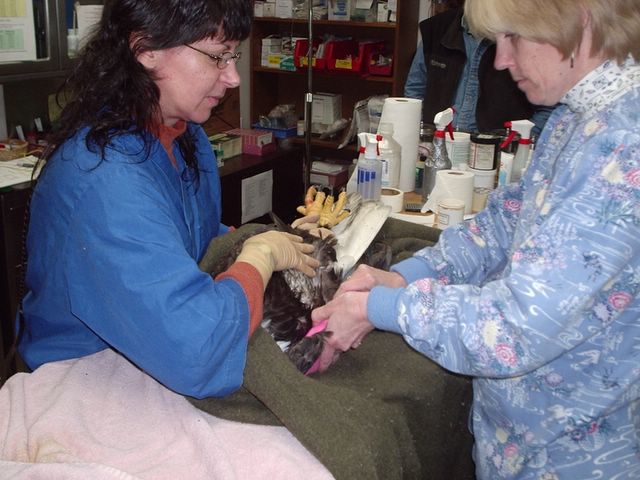
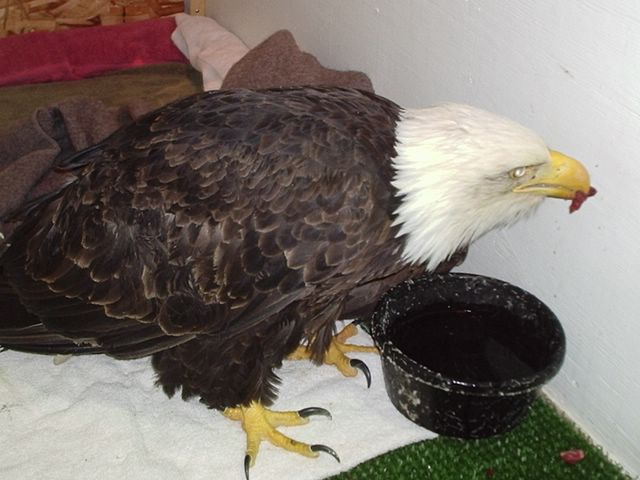
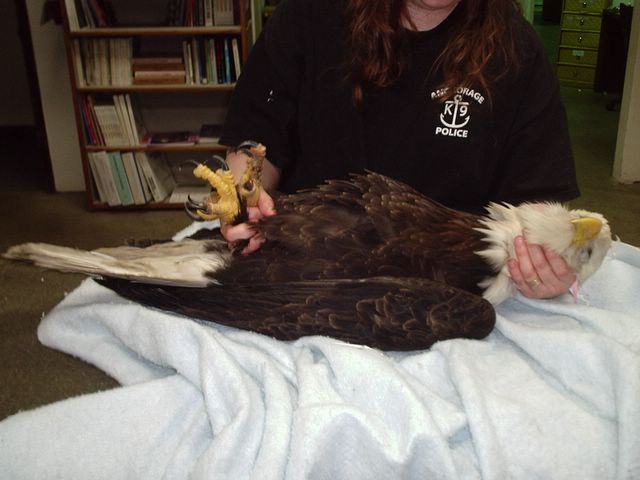
New eagle handler and Wednesday's crew member Char transfers BE 05-17 from the exam table and back to his mew. This bird came to Bird TLC from Cordova. He had eaten some rotten food and feels real bad. He had to have his crop flushed.

Good job Shara! Keep it up!

Cindy, what's that look for?

Thursday, March 10, 2005

Besides eagles


Eagles aren't the only ones coming in now. This Pine Grosbeak flew into a window and a concerned young lady brought him in. Under examination it was discovered it also had scaly leg mites. It has recovered from the window hit, and now must wait for the mites to go away. Then it will be released.

Wednesday, March 09, 2005

Go getter needed

Bird TLC is a growing non-profit organization. We're headed into our Bird TLC 2005 Membership Drive in just a short time. We are in need of a energetic person to chair the Membership Committee.

1st requirement - Must be a member
2nd requirement - Must live in Anchorage, Alaska
3rd requirement - Call the Bird TLC Office @ 562-4852

The mew is mine!


I've written about One Wing before many times, but here's this to bring you up to date without going back through all the archives.One Wing has been with Bird TLC since the Exxon Valdez oil spill in 1989. He lost a wing due to amputation, which is no longer allowed by law. He was oil covered and he beat his wing on the beach trying to take off. He was used for blood transfusions to help save many other eagles during that time. It's a miracle that he survived. He's one tough bird and everyone has a lot of respect for him, including myself.

I went in his mew last week to help Luz, a Bird TLC volunteer. Old Witch (not in picture), has been with him a long time. She was leary of my presence and wouldn't come from behind a tree stump. Though I talk to One Wing quite often, he didn't appreciate my visit that day because I was making Old Witch uncomfortable. He was letting me know very verbally and also by his actions. Needless to say I didn't stay long.

I hope he gets over it by summer time. His mew needs to be re-graveled, some roof repairs and a good pressure wash. We'll have some quality time.

Saturday, March 05, 2005

Not bird related, so sue me


This picture was taken about 1 block from my house of our favorite Iditarod Musher Dee Dee Jonroe. She's a breast cancer survivor about 1 1/2 years ago. She's the woman in the blue mushers hat bent over talking to the woman in her sled basket. People from around the world pay big bucks to ride in that sled from Anchorage to Eagle River. From there to Nome the musher rides alone.

Notice the booties on the dogs feet to protect them from the coarse snow. These dogs love to run. Blue bandanas for the team colors. White "T" shirts on two dogs of every team to promote getting your kids immunization shots.

There's a link in the right column under the hit counter to Cabelos daily race coverage for those interested.

Best of luck to all of the mushers in Iditarod 2005!

Friday, March 04, 2005

Another from Dutch Harbor


This immature bald eagle (BE 05-16) suffered some severe head trauma while in Dutch Harbor. Dr Todd Palmatire and Cindy picked her up at the Anchorage Airport around 4:30 PM last night. Thanks again PenAir.

She's huge for he age. The primary feathers on her wings have quills at least 1/4 inch thick. She flew into something hard. She has some permanent damage to her right eye. She also gave USF&W a hard time. While she was avoiding capture, she jumped into the Bering Sea. They had to go fetch her. She was a little wet still and a little cold when she arrived.

She had that head trauma, head tic so we gave her a shot of dex. No other problems were noted in her exam. She weighed in at 5.18 KG with a full keel. Placed her in a warm mew with fresh water and some moose meat. Let's see how she is doing in the morning.

Wednesday, March 02, 2005

I feel much better thank you!


Lead Bottom (BE 05-01) is doing a lot better. He's on no special medical treatment now. We're monitoring his food and water. He's still drinking a lot and on his own. Had his blood drawn today, results tomorrow. His lungs sound clear (YEAH!). He still has a lack of movement in his left wing. It's kept wrapped up and out of the way so he doesn't damage it walking around. His left leg and foot is working, however he's not completely steady. He's also still being tung feed.

Monday, February 28, 2005

Another Trap Bird


Another trap bird (BE 05-15) was brought in by USF&W this afternoon. They found him very shortly after he got caught. One foot had some abrasions, his left wing had some abrasions, his right wing has a possible fracture. Tomorrow he goes in for x-rays.

Saturday, February 26, 2005

We have a new Exec Director

The Bird Treatment and Learning Center hired Rachel Morse as executive director. Rachel has a master's in forestry and natural resources management and five years experience with Alaska nonprofits.

I meet with Rachel over coffee last Wednesday (dah, took no picture) and we discused the computer side of Bird TLC. She got my opinion of "we have the best computers next to nothing". So one of her first projects (of many) is to get Bird TLC into the 21st century. We'll develope a technology program and go after grants to make that program happen. Aquire new pc's, have them networked, a webcam maybe, DSL, a members only access area in the website and much more. She's a modern woman and visions Bird TLC being a more modern organization. She seemed very motivated with lots of ideas and wanting constructive feedback on what the organization needs or doesn't need anymore.

I look forward to working with Rachel and I also looking forward to what she'll do for the Bird Treatment and Learning Center.

Friday, February 25, 2005

Good News & Not So Good News


While we are thinking in the back of our minds about how long we are going to treat BE 05-01 (Lead Bottom) or is it time to let him go to rest in the big nest in the sky, all along he has other plans. Cindy went to work this morning wondering if she was going to have to make a decission that she or anyone else doesn't want to make. She walks down the indoor mews and there is Lead Bottom standing on his two feet looking back at her. After having his stroke he wasn't standing on his own, but he never gave up the fight. He ate when assisted and drank when assisted. He still needs help there, but being on his feet on his own is a giant step. Continue keeping your feathers crossed, it's working.

On the Bad News side, BE 05-08 was found dead in his mew this morning. This gorgous bird was unable to overcome being caught in a trap without food or water for what we figure was a week. He was too far gone once he got to Bird TLC and all of the IV's and tube feeding only helped him hold on for a short while. I'll miss this brave bird and hope he's in a better place now. He deserves it.

Thursday, February 24, 2005

More updates

Here's a more up to date status on the eagles.

BE 05-01 - Stopped tube feeding due to regurgetation. Tong feed salmon, salmon slurry or baby food / pedialyte. As much as he will eat. He does eat it on his own.

BE 05-06 - Biggest hold back is her tendon damage. R&R.

BE 05-10 - Multiple fx to left wing. Radus is intact. Wrap is holding break in place.

BE 05-11 - Not eating on his own. Rt wing is drooping but no damage to it.

BE 05-12 - Passed away. Very sad, was a beautiful bird.

Ruth and I go to the airport again tonight to pick up a bald eagle coming in from Kodiak with a possible broken wing. Will update later.

Tuesday, February 22, 2005

Here's what we got

Here's what we got at Bird TLC for bald eagles.

BE 04-27 - Came in last year from Valdez under weight and couldn't gain altitude. Was being picked on by other eagles. Non-releasable, but is being evaluated for permanent placement at another facility.

BE 05-01 - (Lead Bottom) - Our toxic poisoning eagle that now has suffered a stroke.

BE 05-04 - We think he flew into something. Blind in one eye and has a neck laceration. Wait and see.

BE 05-05 - Somehow got a left wing tendon injury. Needs plenty rest & relaxation (R&R). (me too!)

BE 05-06 - Immature bald eagle, with rt wing tendon damage, dislocation, and an open wound. R&R here also.

BE 05-08 - Our trap caught eagle. Missing digits, emaciated & dehydrated. Still not eating on own.

BE 05-09 - Immature bald eagle. Severe head trama. Presently blind and we think deaf. Blood has cleared out of one eye. Eats good when feed with forcep. We have to wait and see how he improves.

BE 05-10 - Came from Dutch Harbor, car hit. Possible fracture to lt wrist. Going in for x-rays today.

BE 05-11 - (Sparkie) Powerline electrocution. Eating and pooping well. We think it was a mild shock. R&R here also.

BE 05-12 - This one came in last night from Sand Point. Was thrown into something by high winds. Possible lt wing high fracture. Also has an eye deformity or old wound. Rt eye lid is fuzed closed. Going in for x-rays today.

All eagles recieve daily vitamin shots, clean mew, food (either salmon or moose or both) and water. Their feet are scrubed weekly to help prevent bumble foot and other infections.

Pictures of these birds have been added to the photo album to your right.

Monday, February 21, 2005

BE 05-08 Day 5

BE 05-08 is looking good considering. He's still being tube feed, given IV's and baytril. He's still not eating on his own or showing any interest in it yet. He will soon I'm sure. I know I would be tired of that tube being put down my neck by now.

We now have 7 bald eagles at Bird TLC recieving treatment. That's not including another 4 there for rehab and what's at the flight center. We've been busy!

Ruth & I pick up another one tonight at the airport. PenAir is flying in a bald eagle from Sand Point. Cindy will meet us at the clinic.

PenAir is footing the bill again. Thanks PenAir!

The Latest on BE 05-01

It has been determined that BE 05-01 (Lead Bottom) had a vascular accident. In other words, a stroke. It effected his left side, mainly his wing, leg and foot. So he's being treated for that and mild asper. His nystagmis (eye twitch) is gone and his breathing is no longer labored. He will eat on his own if feed with forceps. He'll bite you or talon you if your not careful.

Continue keeping your feathers crossed. He's a fighter but can use all of the help there is.

Sunday, February 20, 2005

Some Great kids

One of the courses this year at Stellar Secondary School is Ornithology. The class decided to host a dance as a fundraiser for Bird TLC. They raised $282.45 and donated it all to help the birds.

A big thanks to the teacher, Scott Hauser, and the Ornithology class. This donation will help the birds of Alaska. We accept it at a time when it is needed very much.

With your support...

... "We will continue to provide primary medical care and rehabilitation for sick, injured, or orphaned wild birds; and to provide environmental education for the public through live wild bird programs."

Saturday, February 19, 2005

More Great People

A big thanks to Forest Oil Corporation for a generous donation again this year.

With your support...

... "We will continue to provide primary medical care and rehabilitation for sick, injured, or orphaned wild birds; and to provide environmental education for the public through live wild bird programs."

Turn for the worst

BE 05-01 (Lead Bottom) has taken a turn for the worst. After Ruth and I gave BE 05-08 his IV, we noticed BE 05-01 was laying down behind his perch. We removed his perch and examined him in his mew. He was dehydrated and his breathing was labored. Cindy (Rehab Director) was out of town so we called Barbara Doak (semi-retired Rehab Director). Barbara is 81 years young and I wake her up at 7AM. We told her what was happening and she authorized us to give him an IV of 100 ml of lrs.

LB was diagnosed as having a mild case of aspergillosis (asper) a few days ago. Asper is not uncommon in birds that have gone though a lot of stress or severe health changes. However, for him to take a turn just like that is highly unusual. Dr Todd Palmatier, DVM stopped by later in the day and also examined him. Fridays crew, Deann, Shara along with Cindy (who by now had returned) gave another 100 ml of lrs. His labored breathing was not as bad as earlier.

After we all got together and discused the cituation, we hadn't settled what the cause was of the sudden change. On Thursday when we left he looked just fine. He probably dehydrated when he stopped drinking because of his breathing. Asper generally doesn't make the birds cituation change so radically. We researched and couldn't find any known allergic reactions to the meds he's taking for asper. We're hopping that it's some type of airway obstruction that's slowly clearing up. We don't have access to a scope to send down his throat to find out.

After all he's gone through this year, I hope he overcomes this. He has fought so well to overcome the toxic poisoning. Ruth is going in this morning to feed the goshawk she presents. She's going to call me with an update. Keep your feathers crossed.

Ruth just called. His breathing is not as labored, but no other changes.

NOTE: You might be curious as to what the letters and numbers BE 05-01 and BE 05-08 and so on mean. We log all birds that come into Bird TLC and assign them a log number to keep tract of them. Blad Eagles must be on their own log, a requirement of USF&W. BE stands for Bald Eagle, 05 is the year and the next two digits i.e. 01 are how many we've had that year. BE 05-01 was the first Bald Eagle of the year, BE 05-08 was the eighth.

Here's an excellant article on asper from the State of Michigan, Department of Natural Resources.
http://www.michigan.gov/dnr/0,1607,7-153-10370_12150_12220-26360--

BE 05-08 Day 3

Looking much better today. Ruth and I went in yesterday morning to give him his IV before going to our jobs that pay cash. He's a real challenge to give an IV. His veins are small and some roll on you. However, we got some fluids in him.

Thursday, February 17, 2005

New look

Mike @ 10000birds.com pointed out a template flaw on our blog when viewed by Firefox. Since this is becoming a very popular browser, we couldn't have that. So, I changed to something a little simpler.

In doing this, any custom changes I made in the past was deleted, i.e. links, and stuff. I will add those again shortly as time permits. I got some catching up to do for being sick for a while.

I also had to change to a blog member only posting. If you'd like to post, e-mail me at webmaster@birdtlc.net and we'll get you going. I've sent out invitations to regulars, just reply to the invite and ta da.

Matt @ Creature News, I don't have your e-mail. Drop me an e-mail and I'll get you on board.

Dave

BE 05-08 Day 2


BE 05-08

Boy are we looking better today. We're a long ways from being in the clear, but compared to the picture below, wow what a differance. The eagle gods are looking after this boy now.

Cindy gave him his IV this morning and some baytril. Chris Maack and Dugney tube feed him this afternoon. I bet by Monday he's on solid food. Ruth and I will go in early tomorrow and give him his IV.

This is the second eagle that we've gotten this year that was found caught in a trap.

Wednesday, February 16, 2005

Bad Trapping


BE 05-08

Got a call from Kathleen @ Bird TLC office this afternoon. There was a bald eagle coming in on ERA Aviation flight from Kenai @ 6PM. It had been caught in a trap and had lost one digit on it's right foot already. She wanted to know if I could pick it up. You know my answer, you betcha!

I picked it up at Alaska Airlines Air Cargo @ 6PM. They were on time. Thanks to ERA & Alaska Airlines for their help. Off to Bird TLC. Cindy and Ruth were there waiting when I arrived.

We removed him from the kennel and started an examination. We found one digit missing from the right foot, one digit probably dead, a deep puncher on the left foot pad, he was severly dehydrated and exhausted. IV was started immediately to get some fluids in him. We also tube feed him for he had a sharp keal from probably not eating for a few days. His weight was at 3 kilo grams, a little on the light side. We placed him in a mew. He was standing on his own, but was disoriented.

Tomorrow morning he'll get another IV and baytril. We'll keep our feathers crossed.

Remember BE 05-01


Remember BE 05-01

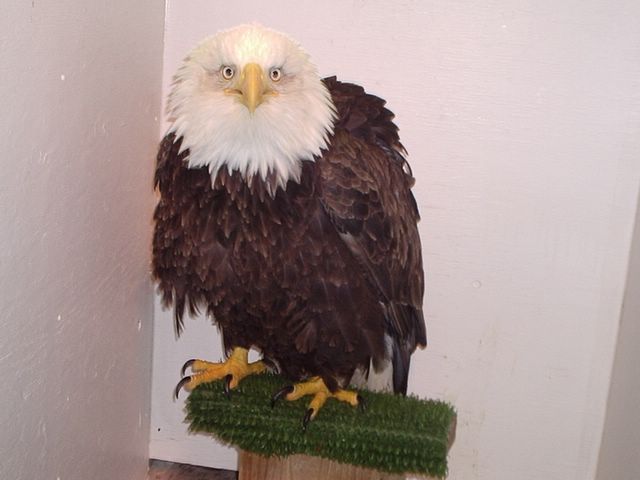
He's doing just fine, even though I ruffeled his feathers when I took his picture. He has developed a little bit of asper for which he's being treated for. All signs of the toxic poisoning is gone. He eats well, caws at anyone who goes near his mew and is a fine looking eagle. Hopefully he'll be released this summer.

Sorry I've not posted in a few weeks. Work got in the way and I was sick for a few weeks.

Comments: To post a comment now you have to be a team member of the blog. This is being done as a precaution because of our non-profit status. If you would like to be a team member and able to post comments, e-mail me @ webmaster@birdtlc.net . After approval, you'll be able to post to your hearts content.

Friday, January 21, 2005

I can eat solid food


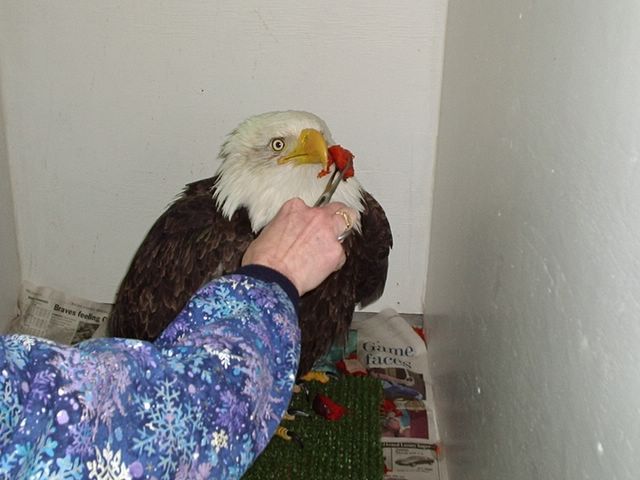
Great news. BE 05-01 ate some salmon this afternoon. Cindy was persistent, putting it in his face to the point of ticking him off. Then he decided that he wanted to see what the fuss was about. He took the piece away from Cindy and chowed down. We gave him a little more and then he was cleaning up what we dropped on the mew floor. He remembered what he was missing and I don't think he liked tube feeding. At this rate he should do real well. Please continue to keep your fingers crossed.

Earlier in the day Lauren Maxwell from KTVA Channel 11 came by and did a news story. The Channel 11 crew gave a good pitch on why not to use lead shot. Thanks for the support folks!

Here's another link telling you why you should use steel shot and not lead shot or lead weights or sinkers. www.wdfw.wa.gov/wlm/game/water/nontoxicshotfinal.htm
Check it out.

*** ACTION ALERT *** ACTION ALERT *** ACTION ALERT ***

Medical care of this beautiful eagle has run Bird TLC a little dry on funds. Fortunately we're able to keep him on his perch. If you can, please call the office with a donation. The number is 907-562-4852 or mail to

Bird Treatment and Learning Center
P.O. Box 230496
Anchorage, AK 99523

For: BE 05-01

*** ACTION ALERT *** ACTION ALERT *** ACTION ALERT ***

There won't be any new post for a few weeks. I'm being dragged away but should be back online the second week of February. Thanks for your support!

Wednesday, January 19, 2005

BE 05-01 Day 3


He's still looking OK, but not as well as yesterday. He's drinking on his own but needs to be tube feed twice a day. He tried to get some of Cindy's thumb today. He is regurgitating some of the feeding though. He's still on his feet so that's a good sign.

When I went by the center yesterday without my camera (dah), he was facing the door looking real good. Today with camera in hand he would not turn around anymore than what's in the picture.

Tuesday, January 18, 2005

BE 05-01 Day 2

He's looking a little better today. He's setting on a low perch, his wings aren't drooping as much and he watched every move I made. Keep your fingers crossed.

Monday, January 17, 2005

Get the lead out


Our first bald eagle of the new year, BE 05-01 came to us from Kenai, Alaska. He was given a physical exam while under sedation and it revealed that the first 2/3 of the birds tongue was necrotic. It was presumed that the bird had ingested some sort of chemical that was causing the illness.

The birds condition deteriated since he arrived despite IV fluids, vitamins and forced feeding.

Blood work performed indicated a high probability of heavy metal toxicity, ie lead or zinc. The blood glucose was incredibly high, perhaps causing the necrosis of the tongue.

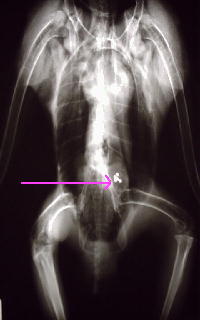
X-rays were taken on 1/17 and showed bird shot in the lower stomach area. He wasn't shot but ate something that had been shot. Surgery was performed by both Dr Wilson & Dr Palmatier of Pet Stop. They removed 6 lead pellets.

The prognosis is poor, but he looks better than when I first saw him. He's reacting to anything compared to nothing. He requires IM injections of Calcium EDTA three times daily for 5 days. Due to surgery he will need to be tube feed for 5 days, twice daily.

Now, my 2 cents.

First, thanks to Dr Wilson & Dr Palmatier for the surgery. Time & expenses was donated by both. You guys are awesome.

Second, Thanks to Pet Emergency Clinic of Anchorage for donating 3 vials of Calcium EDTA. You got him the medication he needed right away.

Third, Hunting, recreational shooting, and fishing deposit thousands of tons of lead ammunition and tackle into the environment annually, exposing dozens of bird species and other wildlife to the toxic effects of lead poisoning. Many animals are directly exposed to lead when they mistake fragments for food or grit. Waterfowl, shorebirds, upland game birds, small mammals and songbirds often consume lead shot or fishing sinkers when they browse for small pebbles, seeds, or other food items. Raptors and other predatory animals are subject to secondary poisoning by preying on lead-laden birds and mammals, or by scavenging contaminated carcasses.

Lead absorbed into the blood stream causes severe health consequences including neurological disorders, seizures, infertility, anemia, soft tissue damage, birth defects and death. Animals that do not die directly from lead poisoning may face sub-lethal effects of lead toxicity, such as neurological and organ damage, that ultimately contribute to their inability to survive in the wild.

Explore non-lead alternatives for ammunition and fishing tackle. Voluntary change to non-toxic substitutes will help keep the environment free of poisons and give outdoor enthusiasts the gratifying opportunity to preserve the nature that they dearly treasure.

Here's a link to HawkWatch Internationals, Life Without Lead.

ACTION ALERT * ACTION ALERT * ACTION ALERT * ACTION ALERT *

Bird TLC can use some assistance paying for the medication for this bird. Pet Emergency Clinic donated what they had. 3 more vials of Calcium EDTA is needed. The pharmacy bill is $146.34. If you can help out, contact the Bird TLC Office immediately @ 907-562-4852. Thanks!

ACTION ALERT * ACTION ALERT * ACTION ALERT * ACTION ALERT *

Sunday, January 16, 2005

Another blog

I've moved all news and comments about the ship wreck disaster of the Selendang Ayu over to a new blog. That blog is in no way affiliated with the Bird Treatment and Learning Center (Bird TLC). It's strictly my thoughts and comments on the situation off Unalaska. Come visit and let me know what you think.

http://spaces.msn.com/members/salendangayu/

I went with MSN Spaces for a host. I liked the layouts, options and the ease of posting.

Saturday, January 15, 2005

Sign up to the online petition

I found this link on Creature News. It definitely worth signing, I did.

Bird organizations throughout Europe are urging everyone keen to see wildlife given a future to sign this innovative 'cyberpetition' - in the form of a postcard. And from today (13 January) there are just 60 days left before we must send all the signatures to the new agriculture commissioner, Mariann Fisher Boel.

It is vital she becomes a driving force behind agriculture reform and works to ensure that the way we farm takes wildlife into account.

Signing the petition involves just three clicks on your computer. Click the petition link on this page, then click on the postcard to add your name to the thousands of others who have called for a better future for Europe's wildlife.

Please pass this onto your friends and colleagues and within 60 days we could have thousands, if not millions, of people urging the EU to held save our wildlife.

Source: Dr Mark Avery, RSPB Director of Conservation

Petition Link

Friday, January 14, 2005

Officials investigate reports of oil patties near Dutch Harbor

Thursday, January 13, 2005 - by Dan Fiorucci

Anchorage, Alaska - There are new reasons to be worried tonight at the site of a wrecked freighter in the Aleutian Islands.

The Unified Command is reporting that tar patties have been spotted in Captain's Bay, located about a mile southwest of Dutch Harbor. Dutch Harbor is nearly 50 miles from the wreck of the Selendang Ayu.

If the tar is from the wreck, then it would mean oil has spread much farther than anyone suspected. There are fears that up to 300,000 gallons of intermediate fuel may have leaked from the Selendang Ayu, making it the worst oil spill in Alaska since the Exxon Valdez.

The Unified Command expects to know later tonight whether the tar patties are indeed from the wrecked freighter.

Thursday, January 13, 2005

More raven stuff

Sometime things can be kind of funny. Since I made the post on One of my favorites the Common Raven and Irresponsible People, plus a well noticed letter to the editor, I've become a little more popular around town. This is something I'm not use to. I am a salesman and yes I am a talker, but I'm not use to a lot of attention.

For Irresponsible People I've received all kinds of good comments from my friends, customers, my dentist's receptionist, the espresso girl, etc. I thank them all. The folks at Bird TLC thought I was a little borderline on getting a little too political, but they agreed with me. So it put me in a happier New Year mood.

Today it warmed up to +5F with a wind chill of -7F. There are ravens everywhere. While visiting one of my accounts we saw a raven outside having a dispute with a mound of snow. I don't know what that mound did to him, but it ticked him off. He was cawing at it and jumping on it and then off. We got a good giggle out of it. It went on for at least a half hour. We told stories of our raven experiences and so on. I finally had to leave. As I looked in the rear view mirror as I drove away, there's that raven on top of that mound like king of the mountain.

Ravens have gotten a bad rap over the years. I think if more people would spend sometime just observing these guys for a little while, they would appreciate them a little more. I remember growing up and there were cartoons of ravens on TV. Those guys must of watched them before making the cartoon. Ravens to me are the raccoons of the bird world. As Matt said over at Creature News, Don't mess with Odin's bird!

Tuesday, January 11, 2005

Bad Bird Catcher

This year I've been called on my cell phone four times from the Bird TLC office asking if I had time to go catch an injured bird and bring it in. They know I'll take the time, but so far this year it's been a little depressing.

Bird TLC got a call from a little old lady in Mt View, an older subdivision in Anchorage. She had a raven that fell down her basement window well and is just sitting there. Cindy called me and I said sure I'll go. She knows I'm a sucker for ravens anyways. First I had to run to the clinic and get a kennel and then to Mt View. Sure enough, there he was.

Now as I've said before, I quit smoking almost 5 years ago. The adverse effect was gaining 30 lbs. This window well was about 4 feet deep and a little narrow. Getting into it was no problem and I caught the bird with little resistance. I set him outside the well on the ground wrapped in a blanket. Now it was my turn. Good thing that little old lady was there to offer me a hand getting out.

I took Mr Raven back to the clinic where we were able to exam him right away. Unfortunately his wing was broken in several places badly where it joins to the body and had been broken for a little while. I went home bummed out.

Next call was that there was a raven that won't fly on the corner of Old Seward Hwy and Dimond Blvd near the old bank. OK. Big intersection. Probably the 4th busiest in Alaska for traffic. Go to parking lot of the old bank and look around. No bird. Talk to a few people and they haven't seen him.

Then I see a raven jumping around. I watch him for a bit and decided that must be him. Most birds would have taken off when I approached. Not this one. He decided to walk away. So I'm following him, holding out a large purple blanket to cover him once I get close enough. In the back of my mind I see this headline in the Anchorage Daily News "Local man goes nuts and goes after ravens with purple blanket". He seemed to like the chase because his pace picked up. As I almost had him cornered he turned and took off flying. Wrong bird. I never found whatever one the phone call was about.

Next call was that there was a raven on the ground not flying and one wing was dragging low on New Seward and Dimond. OK. Big intersection with an over pass, cloverleaf and right during rush hour and it's dark. It's probably the 2nd worst intersection for traffic in Alaska. I go by the clinic and pick up a kennel and off I go. It was all I could do to look for the bird without being ran into or running into someone. I searched for about an hour in the truck and on foot before I gave up.

Later that night my wife and I went out to dinner. When we left where we ate at, we went up and down Old Seward Highway a few times. I figured with a lookout in the passenger seat could help, but no bird.

The next day while at work I drove past the area a few times. No bird. I'm 1 for 3 and the 1 was not that good.

Yesterday I get a call from the office. There's a small bird outside the main entrance of an office building on Minnesota & Benson and it wont move. Can you go fetch? I still have a kennel for a raven in back of my truck (a little over kill), so off I go. I drive right to the place and look down and there's a Bohemian Waxwing all balled up next to the curb trying to stay warm (it was about +18F). He was an obvious window hit. I picked him up and put him in the huge kennel while he bites the heck out of my hand. Off we go to the clinic. Take the kennel out and carry it to the exam room while I take comments on a little too large of a kennel. Cindy opens the door and the waxwing had already passed on. I went home bummed out.

So I'm 2 for 4 but the 2 are not that good. I wish we could have done more, but sometimes that's the way it's meant to be.


Saturday, January 08, 2005

Friday, January 07, 2005

Clean up continues

442,000 GALLONS: The majority of onboard fuel is now presumed lost.

Bolstered by relatively calm seas, a salvage team continued fuel removal efforts Thursday from the wrecked Selendang Ayu off the coast of Unalaska Island in the Aleutians.

The freighter grounded and broke up off the coast of Unalaska a month ago tomorrow. Mother nature and other complications have not been cooperating until recent. Check out this story from Anchorage Daily News.

Wednesday, January 05, 2005

My Favorite Weblogs / sites

We all have them. The ones I like I check out about every other day, more if I don't have to go to work. Less if it's summer time. They have no borders. For me that's good. Alaska is bordered by Canada on one side and oceans on all the others. It's closer to Russia then the next state.

I like blogs / sites with a variety of information. Sure, mine are all about birds and bird rehabilitation and avian education. But I like all wildlife, all animals.

On Bird Forum I posted pictures of a young moose in my back yard and another in a wading pool. They got a good giggle out of those. There's lots of info, pictures and lots of people to ask for info. There are experts and newbies from all over. There's lots of stuff! This forum is huge. It's ranked #1 with the Bird Top 100.

On Creature News he post on all animals alive and extinct (Extinct Giant Eagle Was Really Big (shock). His stories link to other blogs or websites that relate, or the story is on the page that's linked. There are also links to some interesting blogs / sites. It's laid out great and is easy to read (even in English, hehe). The colors are easy on the eyes. He has a very good listing of non-profits you can give some cash to or the Tsunami Disaster. I really like that it has a photo album on the front page. There's also some short reviews on books that are available through Amazon.com.

10,000 Birds - Mike and the Core Team are at bird count #298 and do an awesome job of relating their adventures to us. They visited our fine state about 2 years ago. It's ranked #26 with the Bird Top 100. I (or www.birdtlc.net) have trouble breaking into under 100. He has some great links also and you can shop on Amazon.com or get a bumper sticker. It can get a little political. It's a territory I can't go because of our non-profit status. We don't want to tic anyone off. Sometimes I'm jealous. I like when he post pictures of birds and you have to e-mail him to see if you identified them correctly. He posted a picture that I sent him of a Northern Goshawk. Later that summer, my wife Ruth and I released it back to the wild outside Hope, AK on a trip back to Anchorage. It was KEWL!

Birding Babylon - As a retired US Air Force aircraft mechanic, I'm a little jealous of John. He has access to modern technology in a war zone that I couldn't get in peace time. Of course I've been retired longer than he's probably been in. He has a gift of words for birding and when he runs out of birds he covers bugs, plants and whatever else that is neat that is around him. He informs us on a place that can be beautiful in it's own if it weren't for the ugliness in man.

The City Birder - Rob's Red-tailed Hawks and other wildlife observations from around Brooklyn and NYC. He does an excellent job of relating his experiences. He states that birds and nature are his passion and you can tell in his stories and his pictures.

So, these are the places I go when I go birding around cyber space. Some are top ranked and some aren't ranked at all. But everyone of them is tops with me.

I have yet to find another weblog on wild bird rehabilitation. I know tons of websites for them and most are great, but I have yet to find a weblog open for discussion on wild bird rehab. If you know of one, please forward the url. Thanks!


Tuesday, January 04, 2005

Still trying


X-rays were taken on 12/30/04 for our eagle. The news is not looking too good. While there is a small amount of calcification (1), it's not nearly what it should be after 4 weeks.

It also appears the the bone itself is degenerating at differant spots along the length of the bone (2&3). This could indicate a deep seated infection in the bone itself.

The Plan:
After Cindy discussed things with Dr. Wilson & Dr. Palmatier, it was decided to rest the bird for two more weeks with the apparatus in place. At that time we will be at the limits of the usefulness of the appliance and it will need to be removed. At that time, if the bone has not healed sufficiently to support the bird, we will have to let him move on.

Keep your fingers crossed.

One of my favorites


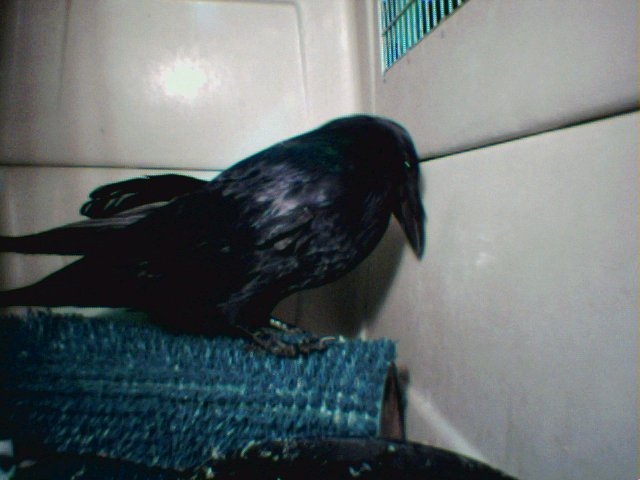
The Common Raven is one of my favorite birds. It's a beautiful bird with all black feathers. A scavenging omnivore and it's found in nearly every habitat throughout Alaska. They are large, intelligent birds usually found together with others of their kind. They often congregate near human settlements during non-breeding times. They can be minor nuisances by scattering unattended garbage and stealing food set out for dogs. They will come to baited traps, which is unfortunate for trapper and bird alike. They're related to the crow and magpie.

The one pictured above had a wing injury. Don't know how he got it, he was found hoping around. He probably got it trying to do something he shouldn't have, obviously.

They are sneaky birds and excellent escape artist. A lot of people don't care for them because they're scavengers. Somebody has to clean up. They do eat live prey also. Mostly small animals or rodents. There have been stories of them taking a reindeer or elk.

The raven has often played important roles in cultures, mythologies, and writings. Ravens disobeyed Noah during the great flood by failing to return to the ark after being sent to search for land.

The raven was used as an emblem by raiding Viking warriors in Europe, and has been written-up in countless disparaging ways in western literature.

In Norse mythology, the god Odin used two ravens named Thought and Memory, to fly the world each day in order to inform him of what was happening.

The spiritual importance of the raven to Alaska's Native people is still recognized. The Tlingit, Haida, Tsimshian, BellaBella, and Kwakiutl all viewed the raven as the creator of the world and bringer of daylight. The raven is also important in the creation of myths by the Eskimo. The myths of the raven remain a significant social and religious component of Alaska culture.

The good news. The Migratory Bird Treaty between the United States, Canada and Mexico was amended in 1972 to include the Corvids, thus giving federal protection to these species. Leave them alone if you like them or not. Do as I do. I watch them and get a good giggle.

The other good news is that the fellow pictured above was released back to live with mother nature. Here's hoping he learned his lesson and stays away from what brought him to us in the first place.

Sunday, January 02, 2005

New Years Resolution

Everybody makes them and everybody breaks them. We make them in the hopes of bettering ourselves. Hopefully we end up keeping more than we break.

I quit smoking almost 5 years ago. It was on my New Years Resolution list. Actually it was on that list every year for many a year. That wasn't the reason that finally made me quit, but after 26 years of smoking I did. I feel for those who try, but don't succeed. I praise those who have quit and stay smoke free.

But this blog is not about me, it's about Bird TLC and whatever effects them and their (our)birds. So, the resolutions I commit to are for them. Ok, they're for me too. But the ones for me that I list here are Bird TLC related.

So here we go;


  1. I've been posting almost everyday about the Selendang Ayu ship wreck off of the coast of Unalaska. This is most important to me and should also be to everyone in my opinion. I don't want this to slip back in the news pages and be as popular as the opening of a new Pizza Hut. But am I doing this at the expense of loosing readers that were interested in the bird stories I have posted? Maybe. So I'm going to post at least one new Bird TLC related story a week.
  2. I've been volunteering for over 2 years at Bird TLC now. I've done fund raising, public relations, I'm on the Education Committee, I do the website and blog, any errands they need done, injured bird pick up and delivery, and I put sand on the icy parking lot during winter. All of these things are necessary and I also enjoy doing them. But it's not what Bird TLC is about. The Bird Treatment and Learning Center is a non-profit organization dedicated to rehabilitating sick, injured or orphaned wild birds and providing avian education programs to the public. Even though all that I already volunteer to do helps with the rehab part, not enough is done for the avian education part. So I'm going to start training to present a great gray owl. I got with Kelly Benedict to be my mentor and she accepted. She's very knowledgeable about great grays and caretakes one. She was also on the Bird TLC Board, was also the board treasurer, helped big time on the new facility project and lots of other stuff. She's a valuable asset to Bird TLC and I think I can learn from her.

That's it for now. I've learned over the years not to make too many resolutions. They seem to be forgotten if you do. I'll keep you up to date on the oil spill, do more Bird TLC related stories and I'll keep you up to date on my great gray owl training. Good luck on keeping your New Years Resolutions.


Weather stalks oil removal

SELENDANG AYU: Crews make ready to remove fuel from ship.
By PETER PORCO
Anchorage Daily News

Crews have made progress over the last two days preparing to remove the remaining bunker oil from the wreckage of the Selendang Ayu off Unalaska Island in the Aleutians and also in cleaning some of the soiled beaches in the area, a spokesman for the Alaska Department of Environmental Conservation said Saturday.
.
The weather forecast, however, called for weather today and Monday foul enough that actual removal of the fuel could be delayed once again, said Len Marcus.
.
Winter storms contributed to the grounding and subsequent breakup of the 738-foot cargo ship on Dec. 8, and they've been hampering salvage, cleanup and animal-rescue operations for much of the time since.
.
But parts of last week were relatively good-weather days, Marcus said. "Yesterday was a very productive day," he said late Saturday afternoon. "The helicopter to be used for lightering (pumping the oil into tanks that will be flown to Unalaska) made several runs to the wreck. "Workers on the copter brought supplies and equipment to the stern half of the ship, which split in two on the west side of the island outside Skan Bay, spilling oil and fouling beaches, when the vessel's crew couldn't restart its engines.
.
Three tanks in the stern section are thought to hold about 100,000 gallons of the heavy oil, the target of the planned lightering operation by Houston-based Smit America.
.
At least 40,000 gallons was spilled in the waters outside the bay when the soybean freighter broke up. Authorities have said it's possible even more oil leaked from two main fuel tanks, estimating that additional amount to be as much as 280,000 gallons.
.
The front half of the vessel has sunk, but the back half has remained above the ocean's surface.
The Smit America salvage crews visited the stern portion Tuesday and made some lightering preparations. Poor weather followed and delayed them until Friday when they flew from Unalaska to the ship.
.
They landed, secured their equipment and made other preparations before flying back to Unalaska, Marcus said. The same occurred on Saturday. "The actual fuel removal work itself will probably begin in a day or two of today, weather permitting," he said Saturday.
.
The National Weather Service forecast called for strong winds and high seas for today, Monday and into Tuesday, said Marcus.
.
The break in the weather early last week also gave field workers, whose ranks have swelled to about 100, their first good look at some of the environmental damage caused by the Selendang Ayu's oil.
.
They found the bunker fuel in some beaches had penetrated a foot deep, and they also found signs that foxes and eagles are eating oiled carcasses of birds.
.
Saturday, cleanup workers had planned to concentrate on a marshy area near the shore of Skan Bay where the storms had pushed the oil beyond the beach, according to Marcus. The marsh would not flush out normally as well as the regular beaches can, and the crews wanted to keep the gunk from getting pushed farther into the marsh. But seas were high enough to keep the workers' skiffs from getting there, Marcus said. "So they ended up in Portage Bay, another cleanup area," he said.
.
Besides the lightering of the oil and cleanup of the beaches, workers are also trying to assess the overall contamination of the shores, according to Marcus. And they're also trying to conduct a wildlife survey while collecting live and dead animals where they can.
.
On Monday, 45 seabird carcasses were found in a relatively small area of one beach, according to the U.S. Fish and Wildlife Service. The agency believes many more are dead.

Saturday, January 01, 2005

Still no change

ANCHORAGE (AP) - Bad weather in the Aleutians is delaying plans to off-load oil from the freighter Selendang Ayu.
A salvage team yesterday (Wednesday) was prevented from getting on board the wreck because of strong winds.A weather front was expected to move into the area today (Thursday) with the next break in the weather perhaps Friday.
The 738-foot freighter had an estimated 424-thousand gallons of intermediate fuel oil and 18-thousand gallons of diesel on board when it grounded December 8th off Unalaska Island.The Coast Guard says more than three-quarters of the fuel may already be lost.

Friday, December 31, 2004

Year-in-review, #1: Oil still sits in wrecked freighter

Friday, December 31, 2004 - by Dan Fiorucci

Anchorage, Alaska - Of KTUU’s top 10 Alaska stories of 2004, only one is expected change in a significant way over the next few days. It's the story of the wrecked freighter in the Aleutian Islands. That wreck cost six crewmembers of the Selendang Ayu their lives when a U.S. Coast Guard helicopter sent to rescue them crashed after being hit by a huge wave.
.
Now the freighter, which had almost 500,000 gallons of oil aboard when it ran aground 23 days ago, sits broken in two. Almost one month later, not a single drop of bunker C oil has been offloaded from the Selendang Ayu. But if weather permits, that could change as early as Tuesday.
.
While the island of Unalaska waited weeks for the heavy-lift helicopter to be put in place, absolutely no other attempt to offload oil from the Selendang Ayu has occurred.
.
In the meantime, the bow of the ship, which contains 176,000 gallons of heavy bunker C oil, has sunk. Even before it went under, its oil tanks were known to be venting to the sea.
.
“We have tugs of adequate power and maneuverability to safely maneuver a barge next to the freighter,” said Tom Lakosh, a public interest advocate.
.
Two years ago, Lakosh won an oil spill response case against the Department of Environmental Conservation in the Alaska Supreme Court. Today he says it was a mistake to rely solely on the heavy-lift helicopter to remove oil from the Selendang Ayu.
.
Lakosh says the trans-rec barge should have been brought in immediately to start offloading the Selendang Ayu during good weather windows while the Unified Command waited for the heavy-lift helicopter to arrive.
.
“I'm sure that the barge could safely maneuver and operate in seas of approximately 6 to 10 feet given the capability of the tugs we have,” Lakosh said.
.
Lakosh says the towing drill, conducted in 10-foot seas, demonstrates that high-powered Alyeska tugs stationed in Prince William Sound could have safely maneuvered the trans-rec barge a few hundred feet from the Selendang Ayu. That means offloading could have begun by now.

.
“We've had weather windows quite large enough to totally remove the oil to date,” Lakosh said. “Alls they would need would be a half a day to be able to remove the remaining oil.”

.
The idea of bringing in ships immediately to start offloading the Selendang Ayu has tremendous appeal to the people of Unalaska.

.
“If you've had some people saying that they can bring vessels alongside and pump out, if that's still a possibility during weather windows, I'd go for it,” Unalaska resident Susie Golodoff said.
.
Many Unalaska residents have argued in favor of ship-lightering right from the start of the tragedy. But a representative of the shipper insists using heavy-lift helicopters alone is the best plan for lightering the wreck.

.
“This proposal was the one that was accepted. It was not the least expensive, but it was one that the experts felt had the highest probability of success,” said Howard Hile of Gallagher Marine.
.
The Unified Command said tonight that even though the trans-rec barge and tugs are designed to operate in heavy seas, it's not safe to operate them so close to shore. They believe the helicopter plan is the safest plan for lightering in the Aleutians in winter.
.
I've printed some of that article in bold to get your attention. It's getting more and more obvious that there has got to be a better way of getting the oil off of that wreck. There has been very little acomplished since the disaster happened because of weather. If there are ways that aren't so effected by the weather, they should be highly considered. Or, can they both be attepted during the same time? This is dragging out too long. Lets get this thing cleaned up and behind us. Let us also learn from this.

Have a Safe & Happy New Year!
Dave

Thursday, December 30, 2004

Education Committee Meeting changed

Because of the lack of space at Bird TLC due to the IBRRC responding to the freighter disaster off the Unalaska coast, the Education Committee meeting location has been changed. It will be held on Monday 1/3/05 at The Alaska Bird Center 519 West 8th Avnue, Suite 201.
.
If you need directions, call the Bird TLC Office @ 562-4852.
.


Wednesday, December 29, 2004

Black box recovered

Here is the latest Alaska news from The Associated Press
ANCHORAGE (AP) - The ``black box'' from a downed Coast Guard rescue helicopter was recovered yesterday off Unalaska Island.Six members of the Selendang Ayu died when the helicopter crashed into the Bering Sea shortly before the freighter grounded and broke in half December 8.The data recorder was found Tuesday afternoon by hired divers hired near the stern of the freighter's wreckage, according to Petty Officer Sara Francis.Francis says the box and its data would be made available to the National Transportation Safety Board, which is investigating the crash.
Also, Smit America salvage company spent most yesterday preparing to remove fuel from the Selendang Ayu. The 738-foot freighter had an estimated 424,000 gallons of intermediate fuel oil and 18,000 gallons of diesel on board when it grounded off Unalaska Island.Salvagers know that one of the ship's fuel tanks is empty. They believe two others may be also be empty, meaning more than three-quarters of the fuel already may be lost.

Monday, December 27, 2004

Fuel from shipwreck closes crab fishery

Tests showing that thick brown fuel oil has fouled the sea floor where the freighter Selendang Ayu broke apart on Unalaska Island three weeks ago have prompted the state to close the area to commercial fishing.
.
Most affected will be Tanner crab fishermen from nearby Unalaska who were to begin work Jan. 15.
.
They had hoped to catch a quota of 175,000 pounds - a pittance compared with the big-boat king and snow crab fisheries of the Bering Sea, but an important source of winter income to the small local fleet, said Forrest Bowers, of the Alaska Department of Fish and Game.
.
The closure came as little surprise to most fishermen, Bowers said. Since the ship ran aground and broke up Dec. 8, he said, “I think many of them had it in mind that this could happen, and was probably likely.”
.
Over the weekend, crab pots stuffed with absorbent material were dunked in Makushin Bay to see whether any of the ship’s 424,000 gallons of heavy bunker oil had sunk to the bottom. Six of 21 pots came up oiled.
.
“The state has a zero tolerance policy on contamination of seafood,” Bowers said. A single oil-smudged crab could devastate the state’s reputation as a source of pristine seafood and cost Alaska fishermen millions of dollars in sales.
.
Also Monday, the Alaska Department of Environmental Conservation declared the spill area a “threatened water body.” The agency cited oil on the water and beaches, and noted that additional spills could occur as salvage experts attempt to remove oil still on the ship this week.
.
The fishing closure is not expected to compromise the big Bering Sea snow crab fishery, which also begins Jan. 15. That fleet should harvest 20 million pounds this year. The boats fish far to the north, Bowers said, and will not even pass through the oil spill area on their way into Unalaska to deliver.
.
The closure announced Monday will keep all fishing boats out of Makushin and Skan bays until further notice. The area is rich in bottomfish and cod, but is most popular with crabbers, Bowers said. It is one of just two areas that Unalaska boats can fish for bairdi Tanner crab, though it had been closed for a decade due to low stocks.

Not a Cheerful day

Long time Bird TLC Education Bird, Cheerful the chickadee past away Sunday. It's estimated age was 10 years old. Cheerful was unreleaseable due to a feather disorder. Cheerful was seen all over Alaska during numerous presentations.

Sunday, December 26, 2004

Irresponsible people

I took journalism in high school several decades ago. If I remember one thing about my teacher (who's name I've forgotten), is that he pounded into us to check and make sure our sources are accurate. Ask Dan Rather, he'll agree to that.
.
In today's Anchorage Daily News in the Outdoors Section there's an article by Craig Medred titled "
'Rescuers' torture birds, delude themselves'. If you don't believe me, there's the link for the complete article. It's too big for me to put the whole thing on this blog, but I did address a few parts. I could spend the whole day picking this thing apart.
.
It starts off " Somewhere in America today, a child is going hungry while well-meaning people go to great lengths trying to save oiled Alaska birds destined to die shortly anyway." Why? Because rescuing these birds makes some people feel better about themselves. Because rescuing these birds makes them think they're doing something to benefit the environment."
.
He starts off somewhat correct. I'm sure there are children in America hungry today. I believe everyone does their part to help correct that. I put my change in the red buckets this holiday season going in and out of the stores. I know that will help some.
.
"These people are well meaning and do go to great lengths." These people are dedicated professionals. They're not a couple of back wood hicks with a bucket and a scrub brush. They are not just trying to save birds, they do. If you want proof Craig, I'll show you two that are still around that were caught up in a small, not well known disaster with a ship called Exxon Valdez. And there are plenty others still around from that mistake we didn't learn from.
.
I feel better about myself for being a volunteer at Bird TLC. I know the people at the International Bird Rescue Research Center should feel better about themselves as well. We are making a difference with the environment that mankind is doing a fine job of screwing up.
.
Sure, some birds are not surviving. They are dying from the toxic waste, or being put to sleep to end their suffering because too much damage had been done before IBRRC was able to get to them.
.
Birds are being released back to the wild. No, not where they were picked up from so they can roll around in some more toxic garbage that still hasn't been cleaned up. They are being released where hopefully they can survive.
.
Yes IBRRC did rush to the site from their offices in California. Wait Craig, did you forget they have an office in Anchorage? An Alaskan woman is in charge of that office and rescue center. Do you know her name or where the center (or torture center) is? These people deserve a pat on the back and not the BS in your article. They are spending their holidays helping out our state, our environment.
.

People in your position have a responsibility to tell the truth. Even though your article is an editorial showing your opinion, your information is incorrect. That incorrect information can mislead others. If you need someone to beat on, go after the owners of the Selendang Ayu for all of their mistakes. Go after the people in charge of the spill clean up for their slow and ineffective effort so far. Go after the feds for not having salvage equipment any closer than Amsterdam. Go after the people that aren't making a difference, not the ones that are.
.
As a last note, I feel much better after writing this. I put your article at the bottom of my birds cage.

.
The following was taken from the bottom of the article;
Daily News Outdoor editor Craig Medred can be reached at cmedred@adn.com.

A break in the weather on Firday

Clean-up crews took advantage of a break in the weather to restart oil recovery on Unalaska Island, the site of the grounded freighter Selendang Ayu.
.
The storm that blasted through the Aleutians left the wreckage in much worse shape and may have caused tens of thousands of gallons of bunker fuel to be released from damaged tanks.
.
New pictures of the grounded freighter show the bow section is almost completely submerged. When the Selendang Ayu broke apart, officials estimated the bow section held 176,000 gallons of heavy bunker fuel.
.
Now, little hope remains of retrieving any of that.
.
Salvage equipment from the other side of the globe passed through Anchorage last night. A Japan Airlines flight hauled the equipment from Amsterdam, Holland for Smit Maritime Contractors. The flight required special permission from the U.S. Department of Transportation. “Had we not been able to get the rights from the Department of Transportation, probably this equipment would have had to been trucked out of Amsterdam to another location, flown into another airport in the United States and then brought up to Anchorage and then taken out,” said Morton Plumb Jr. (right), the director of Ted Stevens Anchorage International Airport. A Lynden Air Cargo flight hauled the equipment to Dutch Harbor today.
.
“The smallest amount of oil can get a bird very cold because it affects their insulation,” said Jay Holcomb of the International Bird Rescue and Research Center.
.
The International Bird Rescue and Research Center in Anchorage continues to treat oiled birds. It released four yesterday in Whittier. Caretakers perform blood tests on the birds to check their health, along with feeding them antibiotics. So far they’ve seen auklets, murres, gulls and ducks, but they expect to treat others.
.
“The bad thing about this is it tends to often be toxic for the birds, so in their attempt to get the oil off of their feathers, they preen it and they do that with their mouths. And if they swallow any of it, they can become anemic,” Holcomb said (below).
.
Crews began cleaning oil beaches today after the storm passed. Water skimming is scheduled to begin next week, and crews must also being the complicated task of removing oil from the ship's stern section by helicopter. That’s expected to begin by the first of the year. Crews are hopeful they can remove more than 120,000 gallons of fuel that they believe still remain in the rear section of the wreckage.

Saturday, December 25, 2004

Merry Christmas


Here's hoping everyone has a Safe & Merry Christmas.

Dave

Friday, December 24, 2004

Only 1/2 left

Savage winds and raging seas have nearly sunk the front half of the grounded freighter Selendang Ayu, dashing hopes that any oil still on board might be removed.
.
Only the tip of the football field-long section was visible Thursday during a flight over the shipwreck. Two days earlier, before a major storm slammed the area with winds gusting to 75 mph and seas to 20 feet, the whole bow section was afloat. It was thought to contain as much as 176,000 gallons of thick brown bunker oil.
.
But after viewing photos of the nearly sunken section, "I think we can make the assumption it lost its load," said Leslie Pearson of the Alaska Department of Environmental Conservation.
Salvage experts said it appeared that the forward tank still had oil, which they thought was helping keep the bow afloat. They had hoped to board the section, pump the remaining oil into portable tanks, then haul the tanks some 27 air miles back to Unalaska with heavy-lift helicopters.
.
The rear portion of the 738-foot ship, which ran aground Dec. 8 on a remote shoal on Unalaska Island and then split in half, is no longer listing. But oil spill response commanders say that could be a sign the section is slowly crumbling.
.
They still hope to remove any oil still in the ship's three aft tanks that originally held a total of 191,000 gallons of bunker and almost 20,000 gallons of lighter diesel oil. They are still waiting for equipment to arrive and weather to cooperate before they can begin.
.
In the meantime, state officials hope to undertake tests this weekend to see whether oil has settled to the sea floor around the wreck and how it might affect a crab fishery scheduled to begin Jan. 15.
.
But after hurricane-force winds raked the island earlier this week, the bow section appeared to slide off the shoal on which it was grounded, said Unalaska salvage expert Dan Magone, of Magone Marine Services.
.
"Apparently it was right at the edge of a shoal and it sloughed off" during the storm, Magone said.
.
A light sheen of oil was visible, and little new oil has been seen on nearby beaches, Pearson said. It's hard to say how or when the forward tank may have lost its load, she said. "It could've been releasing some oil from the get-go," she said. "Since we're not seeing much sheen on water, or even in new shoreline locations, it's probably been slowly releasing it over time. But nobody's been in the field (checking beaches) the last couple days, so it's hard to say. "Regardless when it spilled, Pearson said, "It's still there. It's got to be on the beach or somewhere."
.
Even if the bow section slips completely beneath the surface, Pearson said the state will require the ship owners to remove the wreckage, or at least demonstrate why they can't. "They'll have to take a good, hard look at what approaches could be made to remove both sections," she said. "If we can put divers on a subsea pipeline in Cook Inlet to work on (oil) releases," the owners will be expected to consider some way to remove the underwater wreckage of the Selendang Ayu, she said.
.
Oil removal from the aft section is expected to begin around Jan. 1. That still looks feasible, Pearson said. Tests this weekend should provide the first glimpse of how much oil has settled to the bottom of Skan Bay and nearby Makushin Bay. The state will drop crab pots with absorbent pads to see whether any of the heavy bunker oil has sunk.
.
At the same time, crab pots will be baited as usual to see whether crab have ingested oil or been smeared by it.
.
In other tests, a trawl net outfitted with absorbent pads will be towed through the water at different depths and a crab boat will put pads in its circulating water tanks to see if oil is suspended in the water.
.
The Alaska Department of Fish and Game hopes to decide as soon as Monday whether to conduct the bairdi tanner crab fishery set to begin Jan. 15.

Thursday, December 23, 2004

Remember before the spill ...


Remember back on December 7th, I posted x-rays of an eagle with a broken leg and what looked like scaffolding around his leg. Well here's an external picture taken today. Cindy and I went out to the flight center to check him out. He does have a slight case of bumble foot on his right foot which Cindy has been treating and it's making slow progress.
.
On Tuesday he gets x-rayed again to see how it's healing. Keep your fingers crossed.

No good news

Just announced on the 6PM news was that the bow section of the freighter Selendang Ayu is under water and floundering. Experts were saying that it is very doubtful that the forward fuels cells will be able to stay in tact. Weather is still not cooperating.
.
At the end of last week 294 birds were counted on a one mile stretch of beach and at least 196 of them were oiled. Considering this small section of beach in relation to the broad area impacted by the spill, concern is growing about how this is going to impact wildlife in the area.
.
There are 125 Dutch Harbor volunteers trained to handle the birds once they are recovered.

Monday, December 20, 2004

Weather impedes clean-up process

Clean up of oil leaking from a grounded freighter was brought to a standstill today because of dangerous weather conditions.
.
The U.S. Coast Guard says winds gusting up to 70 mph created high seas around Unalaska. That's where the freighter Selendang Ayu grounded and split in half nearly two weeks ago.
.
According to the Coast Guard, clean-up crews were unable to reach beaches stained by oil, and efforts to string boom across creeks also came to a halt. The high winds and rough seas are expected to last at least through the middle of this week.

Sunday, December 19, 2004

Ugly pictures

I've posted pictures of the Selendang Ayu wreckage on the photo album (link in right column). These pictures are taken from the websites of the US Coast Guard, Anchorage Daliy News & KTUU Channel 2 in Anchorage.
.
Sorry for all of the ads on the photo album. It's a free service from Bravenet. They have to pay the bill some how. We can't afford it.

Saturday, December 18, 2004

Soybeans & heating oil, YUCK!

Ominous news from the Unalaska tonight. For the first time since a Malaysian freighter broke in half off the coast, there are signs it is deteriorating.
.
Friday, in increasingly rough seas, brown foam was sighted around the ship. It's a sign that more oil is leaking from it, though no one knows how much.
.
And now soybeans are floating through the water, accumulating on the bottom and piling up knee-deep on beaches near the shipwrecked freighter Selendang Ayu, which broke apart last week on Unalaska Island and began spilling its 66,000-ton load of soybeans.
.
Biologists and cleanup experts are far more concerned about the thick, brown bunker oil that has fouled the area's crystal waters and black-rock beaches. But an Illinois soybean expert said things could get ugly when summer hits the Aleutians.
.
"Enjoy it while you can" this winter, said Emerson Nafziger, a crop science professor at the University of Illinois at Urbana-Champaign. "Once it does get warm, it's going to smell to high heaven."
.
Still, 66,000 tons is a big pile of soybeans, and spill responders aren't quite sure what effect the beans will have on a remote Aleutian island and its birds, marine mammals and shoreside creatures.
.
"This is a new one for us, that's for sure," said Anne Morkill of the Alaska Maritime National Wildlife Refuge, which includes the portion of Unalaska Island where the ship went aground.
.
Soybeans, the quarter-inch-long yellow legumes brimming with oil and protein, are the most valuable export crop for the United States, and China is the country's biggest customer.
.
The Selendang Ayu had packed its seven cargo holds full before it sailed from Tacoma on Nov. 28 for Xiamen, China. A full load for the Malaysian-flagged vessel would settle during transit to some 2.4 million cubic feet, according to the ship's managers, IMC Group.
.
That's enough soybeans to lay a strip four inches deep and four feet wide from Anchorage to Fairbanks or to fill a caravan of 8,900 dump trucks. And when soybeans get wet and swell, the volume can double or triple.
.
Still, the Illinois professor said, "Of all the things that could fall into the water, soybeans are one of the more innocuous."
.
Never having thought about a soybean spill before, Nafziger couldn't offer suggestions on what the beans may do. In fresh water, they sink, he said. "I'm not sure about saltwater."
.
In Skan Bay, where the freighter lies in two pieces, soybeans poured out of the broken hold and apparently sank. As water leaked into the remaining holds, white foam, apparently a by-product of the swelling beans, trailed away from the ship and its holds. When spill responders finally got to the shore nearest the wreck, they found soybeans piled 3 feet deep along a 100-yard stretch of beach.
.
Actually, they found soybean mush, said Dan Magone, the Dutch Harbor salvage expert whose crews waded through it. "It was knee deep," he said, but no longer beanlike. "It's already expanded and puffed out," like oatmeal.
.
Magone, who has been anxious to start cleaning up the wreckage and whatever oil it contains, said he isn't concerned about the soybean scum line around Skan Bay. "It'll degrade in a hurry," he said.
.
Others suggest that, as organic material, the soybeans won't harm the environment. Biologists are hoping that's true but want to analyze some of the material before they call it harmless, said Morkill, deputy manager of the refuge.
.
"I think there are just a lot of questions about whether this is a good or a bad thing," she said. Among their questions is whether soybeans may absorb or attract oil and transport it farther than the oil would normally travel. Soybean experts have said that's unlikely because the beans release a substance that makes it almost impossible for oil to stick.
.
The same experts have told spill responders that even if soybeans survive the oil, the saltwater and the winter, they're not likely to sprout. And if they did, they wouldn't survive the summer.
.
Perhaps a better question is whether other plants may sprout in the wake of the spill. Soybean experts told the spill responders that 2 percent of a soybean ship's cargo is wheat, weeds and other seeds, a total of more than 1,300 tons.
.
Biologists also wonder how animals will react if they eat the beans or the resulting mush. So far, glaucous-winged gulls seem more interested in it than other birds, Morkill said. Many seabirds are carnivores, subsisting largely on small fish.
.
But the bird population in the spill area will soon grow, as other species return for the summer, including threatened Steller's eiders and emperor geese. "It's something we'll just have to keep our eye out for," she said.
.
Soybeans are known as a superb feed for livestock and fish, but that's after processing. The raw beans are just the opposite, according to Nafziger, containing what he called an "antinutritional factor." The protein is hard to digest, he said. If shorebirds ate the beans, "I don't think it would prove toxic, but it may not really advance their cause much."
.
There is some concern that the beans could end up in a thick layer on the ocean floor, said NOAA's Whitney. No one knows what effect the beans may have on crab or bottom fish or how long it would take for the material to decompose, or whether currents would wash the area clear.
.
Fuel has spilled onto shore and into marshland officials said. A shoreline cleanup that began Thursday near Skan Bay had to be halted on Friday because of inclement weather, Hile said.
.
Before the cleanup was stopped, 35 large bags of oily waste had been collected, officials said. A small amount compared what will be needed if all 424,000 gallons spill.
.
Eleven birds covered with oil have been found alive so far, and another six were dead, conservation officials said. One dead sea otter has been found.
.
The rising seas and winter storms are affecting the vessel, the soybeans and the fuel still inside. Further disintegration of the ship is possible if the sea continues to pound it, Hile said. "Storms clearly represent the greatest threat to the integrity of the vessel," Hile said.
.
Snow storms are forecast for the area in the next two days, with wind gusts up to 40 miles per hour expected and seas up to 14 feet, according to National Weather Service spokesman Dave Vonderheide.
.
By Sunday, the wind is expected to shift and come from the east, and the island's peaks could shelter the area, Vonderheide said.
.
Meanwhile Friday, U.S. Sen. Ted Stevens said he hopes the federal government will push to require ships traveling through the Aleutians to have survival suits for all crew members. The Seattle Post-Intelligencer reported that the Selendang Ayu had only three survival suits on board, the minimum required, and Coast Guard rescuers said they saw no evidence of any.

Friday, December 17, 2004

More birds being treated by the IBRRC

There are more birds affected by the fuel spill in Unalaska that have been found. They’re now in Anchorage being treated at the International Bird Rescue Research Center.
.
On Friday, a horned grebe, pelagic cormorant and two common murres are being tube fed. The solution is pedialite, a fluid used with infants and designed to replace electrolytes.
.
Wildlife officials say the birds can easily become dehydrated if they’ve ingested oil, which can cause ulcers. However, they say they’re taking steps when they first capture the birds to lessen the danger to the animal.
.
“We're giving them now medication when they get them in the field and that will help heal the ulcers, or at least coat the ulcer so they don't hemorrhage out and they don’t lose fluids that way,” said Mark Russell of the IBRRC.
Once the birds stabilize, they’ll be washed and placed back in the wild in about two weeks.
.
As for the two birds brought in earlier, the common murre did not make it. However, the long-tailed duck is now washed and in good shape. The center was expecting another four or five birds Friday, and there are reports from Unalaska that 11 birds are being treated in the field and more have been spotted that are in need of assistance.
.
Officials say the fuel spill has killed at least one sea otter and four birds.

Wednesday, December 15, 2004

Bird Out er ah Bug Out er ah Get Out

Well the word came down today from the IBRRC. Get all injured birds to another location. That's not bad. Good thing business is slow.
.
Barbara Callahan is the IBRRC head person in Alaska. She's very good at her job, travels the world doing it. She's very organized but also very fair. Did I leave out she's also nice.
.
So far they've only recovered a few oiled birds from the Unalaska area. They are being sent to Anchorage now for cleaning and recovery. We have to make do until the situation is settled. Fair trade off for what we get in return.
.
Everything right now is hurry up and wait. Until mother nature starts to cooperate, that's all most can due.
.
Cindy Palmatier is getting good training for her job. Thrown right into the fire. She can't say she's bored.

Tuesday, December 14, 2004

A dozen oiled birds found so far

Fewer than a dozen oiled birds and animals have been spotted during the flyovers, but more will be found as observers start walking the beaches, said Barbara Callahan of the International Bird Rescue Research Center.
.
"You would not see those birds" from the air, she said. "They're cold, they're not buoyant, they can't fly. So they go hide."
.
After a spill in the Pribilof Islands several years ago, oiled birds walked 200 yards to hide in the grass, Callahan said. On Unalaska Island, they'll likely be in caves and cracks in the rocks.
.
The first wildlife observers were to start walking beaches around Skan Bay on Monday, if they could land safely. A second ship was headed to the area to become a work station for the wildlife crews.
.
A local salvage expert had the only boats at the spill site until Monday. They placed oil-stopping boom material across the mouths of several salmon streams but could not skim free-floating oil from the water, according to Gary Folley, the state's on-scene coordinator from the Alaska Department of Environmental Conservation.
.
None of the oiled beaches has been cleaned, and the prospects for additional work are poor. A storm was expected to hit the spill area Monday night, bringing 40-knot winds and 18-foot seas.

Monday, December 13, 2004

Freighter oozing more oil

Salvage experts finally reached the grounded and broken up freighter Selendang Ayu during a long-awaited break in weather Sunday and found the ship is in worse shape than they had hoped for.
.
Both halves of the wreck have settled; their bottoms appear to be collapsing. A second large fuel tank was breached and thought to be leaking viscous bunker oil, adding to a spreading spill. A load of soybeans is drifting away.
.
At least one of the ship's main fuel tanks split open, releasing more than 140,000 gallons of heavy oil known as "bunker C." Goopy and brown, it has coated beaches in Skan Bay. Still on board could be as much as 300,000 gallons more.
.
Since the grounding, winds have rarely dropped below 25 mph and have gusted to 60 mph or more. Exposed to the Bering Sea, the ship has been pounded by waves as high as 35 feet.
.
But in Sunday's relative calm, a Coast Guard helicopter lowered three salvage experts onto the aft section of the broken hull. The two halves were parallel as recently as Saturday. By Sunday, the broken end of the bow section had swung toward the stern half.
.
The inspectors were lowered by a basket to the ship's bridge. They reported the vessel rolled slightly as waves slammed it, and photographs show it has settled several feet, even as it rests on the rocky bottom. The hull is likely collapsing under its own weight and the rocking motion.
.
The engine room was flooded, suggesting it was breached. Air surged in and out of a major fuel tank vent, suggesting that water had infiltrated it. One of the two remaining tanks appeared intact, but the other could not be checked.
.
The inspectors found soybeans drifting out of at least one cargo hold. A second was wet, while a third looked dry.
.
They couldn't get on the bow half, but it also looks lower in the water.
.
New estimates suggest less oil was on board than was previously thought. Officials now believe the ship carried 424,000 gallons of bunker oil and 18,000 gallons of diesel.
.
The inspections will help determine how to proceed with the wreckage and oil removal.
.
Overflights spotted more oil in Skan and Makushin bays. An Unalaska-based vessel with cleanup equipment purchased after the last major grounding also took advantage of the weather. The Redeemer set out more protective booms around salmon streams and estuaries and was expected to skim some free-floating oil in Makushin Bay.
.
A second ship with skimming capability and carrying spill workers and biologists was expected to reach the site today.

Go to www.adn.com for pictures.
.
Go to U.S. Fish & Wildlife Service - Alaska - External Affairs for updates.
.
Go to the State of Alaska's Prevention and Emergency Response Program website.

Sunday, December 12, 2004

Salvage crew reaches stricken ship

The weather cleared up some today and the Coast Guard was able to get a salvage crew to the Selendang Ayu. There are some conflicting reports on the amount of heating oil spilled. They range from 40,000 gallons to 140,000 gallons. Some of the oil may have already balled up and sunk. The distances of the oil sheen also varies.
.
The spill is near a wildlife refuge, home to sea lions, harbor seals, sea otters, tanner crabs and halibut. Environmental officials are concerned that resident bald eagles may scavenge on any oiled birds that could wash ashore.
.
More to come as I get it.

Saturday, December 11, 2004

Broken cargo ship creates major oil spill

Friday, December 11, 2004 - Now in two pieces, the Malaysian freighter Selendang Ayu is threatening massive environmental damage on the north shore of Unalaska Island. Marine mammals, waterfowl and salmon hatcheries around Skan Bay are at risk from the oil. It could be the largest ecological disaster since the 1989 Exxon Valdez spill.
.
This disaster could test out Bird TLC's evacuation plan. Bird TLC is a tenant of the International Bird Rescue and Research Center. Our agreement with them is that if there is ever an emergency requiring bird rescue from oil spills in Alaska, we would be required to evacuate the premises within 24 hours. Our volunteers would also assist them in whatever way possible. Right now we don't know the extent of the damage caused by the Selendang Ayu disaster. We also haven't been requested by IBRRC to evacuate. Here's hoping that the test is not required and if it is, it won't be for long.
.
Fortunately rehab business at Bird TLC has been slow. There are only a small amount of injured birds at the center plus the few resident birds. Temporary placement at volunteers homes and our flight center is presently being discussed. We'll keep you updated as things occur.

Tuesday, December 07, 2004

Scaffolding?


No, it's not scaffolding. It's the X-Ray after the operation on the eagle from Seward. It was kind of an intense operation. Inside the leg bone Dr. Palmatier inserted a plastic peg to fit both pieces together. What you see here is everything to hold the bones in place until they heal. We'll X-Ray again in four weeks to make sure it's healing as it's suppose to.
.
This is a most handsome bird. His appetite has been real good during it's stay at Bird TLC.

Thursday, December 02, 2004

Bohemian visitors??


The Bohemian Waxwing is an irregular winter visitor from the far North. It comes primarily to states and provinces along the United States/Canada border, a bit farther southward in the West.
.
We've been getting alot of these at Bird TLC. These 2 are window hits. Both have minor wing injuries. They flunked their first flight test to see if they are ready for release. We'll test them again in about a week.